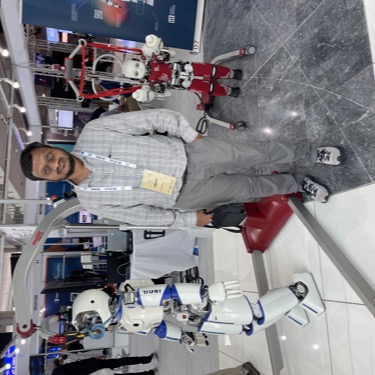
About Me
I am Tushar Vaidya — a researcher and engineer working at the intersection of Embodied AI and Physical Intelligence, with a long-term interest in building systems that allow machines to perceive, learn, and act meaningfully in the real world.
Over the past decade, my work has evolved from foundational research in robotics and computer vision at IIIT Hyderabad, including defence-supported projects with CAIR (Ministry of Defence, Government of India), to developing and deploying large-scale AI systems in industry. This journey has shaped my perspective on bridging theory and practice — not just advancing algorithms, but translating them into reliable systems that operate outside controlled environments.
Currently, as Director of Robotics at DreamVU Inc, Pennsylvania, USA, I lead robotics initiatives spanning embodied AI, perception, and autonomous systems, working to translate research into deployable, real-world robotic products.
Previously, as General Manager & Head of Embodied AI at Meril Group, I worked with a multidisciplinary team exploring humanoid robotics, autonomous ground systems, aerial robotics, and warehouse automation. Our focus spanned reinforcement learning, Vision–Language–Action (VLA) models, sim-to-real transfer, and neural 3D reconstruction, with the broader goal of enabling machines to learn from interaction and adapt in complex, unstructured settings.
Earlier, at Jio’s AI Center of Excellence, I led efforts in building production-grade perception systems — including SLAM, dense mapping, and multi-sensor calibration pipelines — now deployed across thousands of real-world environments. These systems contributed to both operational impact and intellectual property, with patents granted internationally. Alongside this, my research work has been presented at venues such as ICRA and IEEE conferences, and I have had the opportunity to contribute to the community through reviewing and collaboration.
I have also worked with startups such as Standard Cognition and ExplorerAI on large-scale mapping and autonomous systems, and have been fortunate to receive support from organizations like NVIDIA and the Ministry of Defence during earlier research phases. More recently, I have been involved in mentoring early-stage AI and robotics startups at T-Hub.
Looking ahead, my interest lies in contributing to the development of scalable, open, and impactful embodied intelligence systems — particularly in contexts where real-world constraints, data, and deployment challenges shape innovation. I am especially interested in building environments where research, engineering, and product thinking come together to create long-term technological capability.
I see my role not just as building systems, but as helping shape teams and ecosystems that can sustain this work over time.
Leadership & Impact
Mentor — AI & Robotics Startups
Mentoring early-stage AI and Robotics startups at T-Hub, Asia’s largest incubation centre, based in Hyderabad, Telangana, India. Guiding founders on technology architecture, embodied AI strategy, and go-to-market for deep-tech ventures.
Best Reviewer Award — IROS 2025 & 2026
Recognised as Best Reviewer at the IEEE/RSJ International Conference on Intelligent Robots and Systems (IROS) for both 2025 and 2026, reflecting sustained contributions to advancing peer review quality in robotics research.
Skills
- Embodied AI / Physical Intelligence — Robotics Foundation Models (GROOT, π0, RT-2), Isaac Sim, Imitation Learning, VR-based Cloning
- Autonomous Driving — Perception
- Enterprise AI Integration
- Computer Vision & SLAM
- Reinforcement Learning
- AI-Driven Transformation